
Lebanon Previous Residents by Era
The backward trail for a Lebanon address changes with the period. Begin at the current parcel, then choose a source whose dates actually cover the question. Deeds establish a title sequence; cross-reference directories give dated address associations; telephone books and census material add household context; maps explain a building or street setting. A gap in one online system does not mean the address has no history. In Lebanon, the Recorder counter, the Historical Society, and State Archives material are real alternatives when a web path ends.
| Source | Years it covers | Where held | What it can show |
|---|---|---|---|
| County Property Viewer and Assessment file | Current; no start year published | County GIS and Assessment | Address, parcel, UPI, and current owner-of-record starting point. |
| LANDEX deed access | Index: 1813-1878 and 1922-present; images: 1813-1878 and 1926-present | Recorder and LANDEX | Recorded title evidence when the account and period permit access. |
| County deed-index microfilm | 1813-1932 | Lebanon County Historical Society | Historic grantor-grantee bridge across deed research. |
| City cross-reference directories | Individual years not published | Hauck Research Archives | A dated owner or occupant clue for Lebanon City addresses. |
| Telephone directories | 1940-1948 | Library of Congress online | Subscriber, abbreviated address, and telephone association as printed. |
| Sanborn Fire Insurance Map | 1896 | Library of Congress online | Building footprint, use, and street context, not identity. |
Start with the current parcel when the exact location is known. Start with a dated directory or telephone entry when the older address is the only lead, then reconnect it to the legal description before treating it as the same property.
Lebanon Address Starting Point
Use the Lebanon County Property Viewer to locate the present parcel by address or map number. Record the UPI, map number, site address, current owner-of-record context, and deed book or page before moving to title records. Assessment distinguishes a site address from an owner mailing address. That distinction is central to researching previous residents: a correspondence address, a recorded owner, and a person listed at a historical address are three different facts.
Record limit. A property owner is not necessarily every person who lived at the Lebanon address. Treat every name as a dated and role-specific observation until another record confirms it.
Lebanon Previous Residents Deed Chain
A deed trail begins with the latest conveyance, then walks backward through the names and description in that instrument. The grantor is the person transferring the property, and the grantee is the person receiving it. To find the earlier acquisition, search the later seller as a grantee, then compare each description with the UPI, lot language, and earlier deed reference. A matching street number helps, but the legal description is the better continuity check when the address changes.
- Capture the current parcel identifiers and current owner context from the Viewer or Assessment.
- Use the owner, deed book and page, UPI, or legal description to locate the newest recorded conveyance through the Recorder.
- Read the grantor, grantee, recording date, legal description, and prior reference on that conveyance.
- Search the seller as a grantee to find that person’s earlier acquisition, then compare the parcel language again.
- Repeat one transfer at a time, moving to the Recorder counter or historical film when online coverage no longer reaches the year.
- Grantor / grantee
- The grantor transfers an interest; the grantee receives it. Their roles reverse when the trail moves to the prior purchase.
- Chain of title
- The ordered series of recorded transfers used to follow property ownership backward.
- Legal description
- The deed’s parcel description, such as lot or subdivision language. It is more stable than a street label for old-address research.
Lebanon LANDEX Era Gaps
LANDEX is not a street-address search. The Recorder’s system searches recorded documents by party, document information, date, instrument number, or book and page. County-designated coverage divides the deed index into 1813 through 1878 and 1922 to the present. Images are available for 1813 through 1878 and 1926 to the present. That makes 1879 through 1921 a real online index gap, while the early 1920s can have index coverage without the later image coverage.
Coverage gap. A no-result inside this split does not settle the history of previous residents. Check the year, then use the Recorder counter or the Historical Society’s film rather than jumping from one name to a conclusion.
The LANDEX access page shows separate Remote and WebStore routes for recorded-document retrieval.
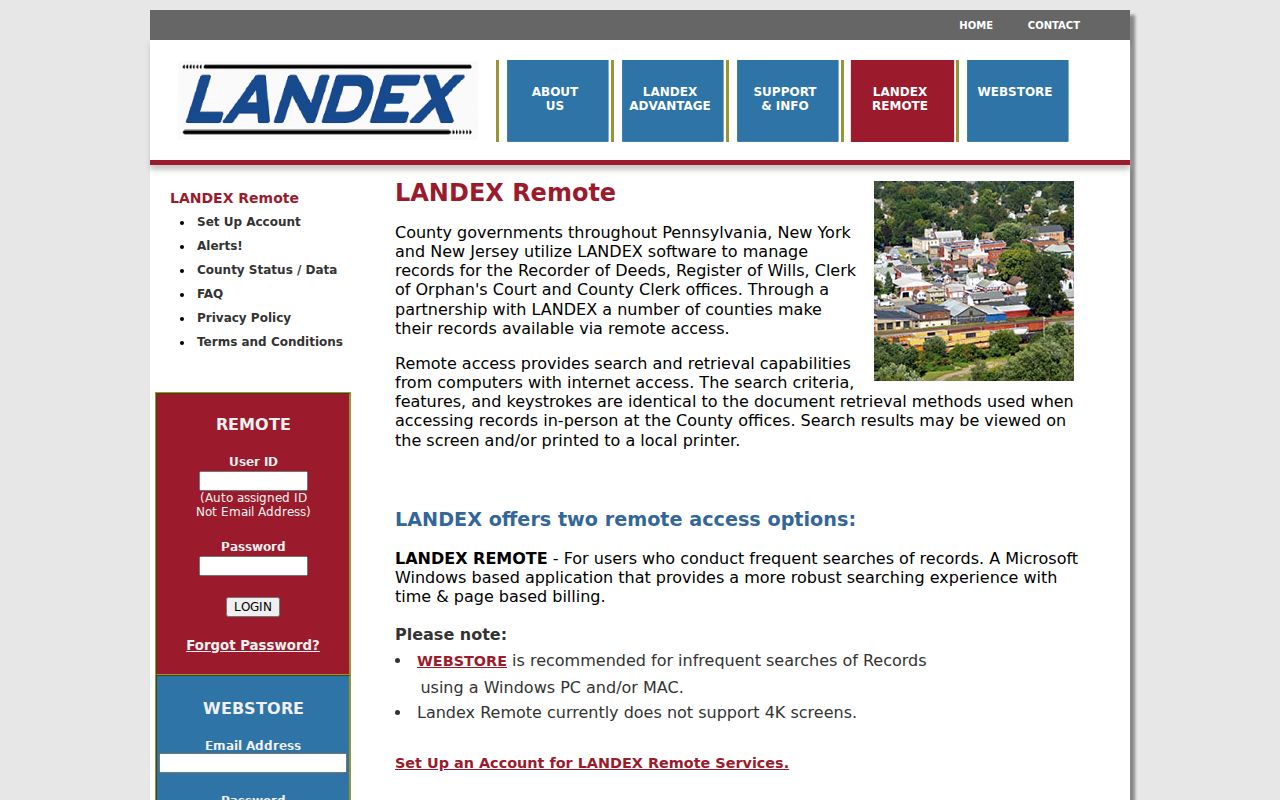
Remote access uses an account arrangement, while WebStore is the browser-based paid document path. Certified copies require the Recorder.
Lebanon Deed Index Microfilm
The Lebanon County Historical Society Hauck Research Archives holds county deed-index microfilm from 1813 through 1932 and original deed collections that support a house-history question. Its cross-reference directories, maps, and newspaper resources can provide context around a transfer. Original archival material and assisted research require an appointment; its research page also documents in-person and remote research routes. The Society does not promise a complete history or photograph file for every property, so record the unanswered period plainly.
Library materials and computers may be consulted without assistance, while original records and guaranteed staff help are appointment-based. The Society lists an $8 floor-research charge and remote research at $25 per hour for nonmembers or $20 per hour for members, with a two-hour minimum. A focused request should name the address, approximate era, municipality, and known names or records instead of asking the archives to construct a complete property history.
Local search tip. The historical reverse-directory shelf is most useful after the address is anchored to a parcel or deed description. It is a Lebanon City resource and does not claim complete coverage for outlying places.
The Lebanon County Recorder of Deeds is the current custodian for recorded-document copies and certified records.
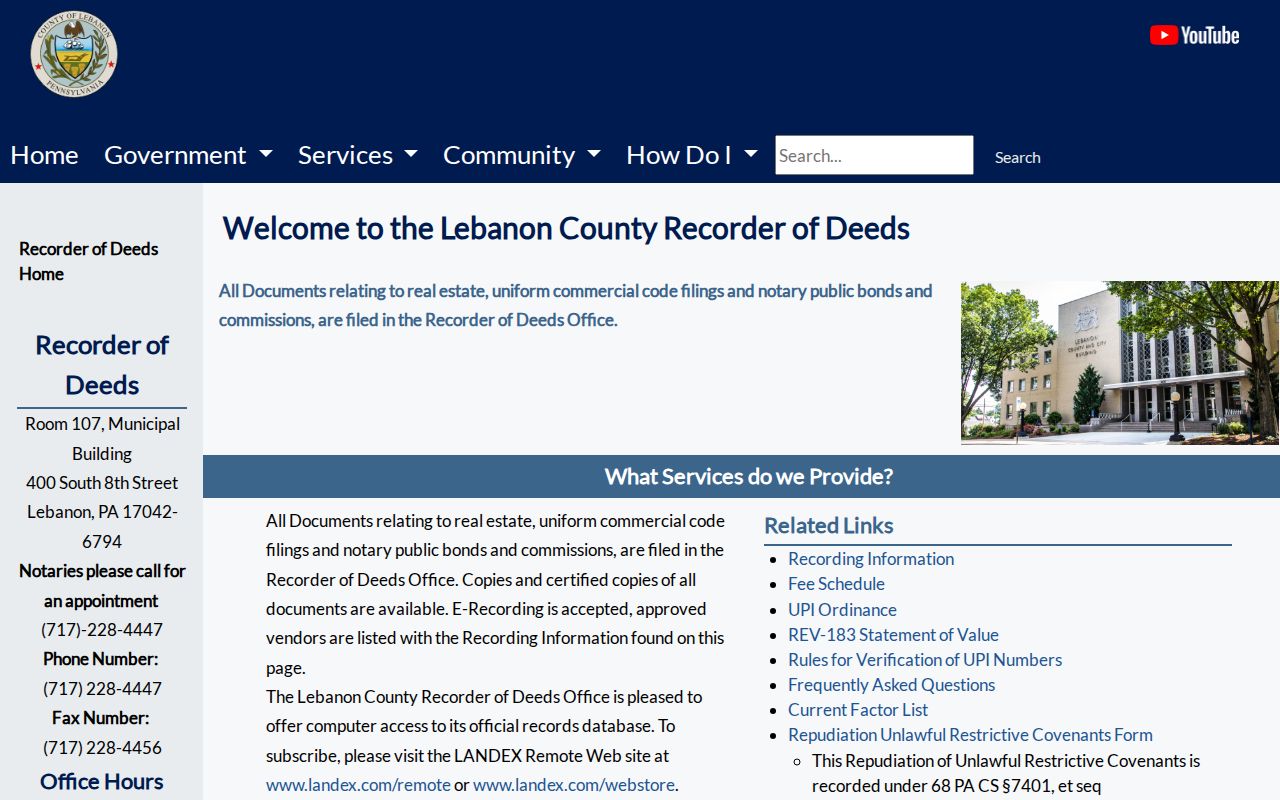
The Recorder page also links to a UPI-keyed property-record alert, which can flag new recording activity but does not replace title review.
Lebanon Reverse Directory Clues
Cross-reference volumes reverse the ordinary name-first approach. Look up the address for a stated year, preserve the listed name and address form, then check the corresponding alphabetical directory or telephone book in the same or an adjacent year. The record may identify an owner or an occupant, but it should not be inflated into a claim about every person at the address. The collection itself is described in the Lebanon city directory collections, where its access limits and neighboring source types are kept together.
When the directory name differs from the deed trail, do not force a match. The recorded owner may be elsewhere, the listing may be a different role, or the address form may need a map and legal-description comparison.
Lebanon Census Phone Checks
Pairing a directory year with the closest released census is a practical way to test a household clue. Federal census schedules follow a statutory 72-year release timing, and an address often needs a directory or map bridge before it can be matched. The Library of Congress digitized Lebanon telephone directory collection covers March 1940 through June 1948. Its white and yellow pages are dated publisher records, not a complete resident roll.
The Library of Congress telephone-directory collection lets a researcher inspect those printed white and yellow pages directly. Preserve the edition month or year, spelling, and abbreviated address before comparing it with a deed or census result.
- Write down the exact address and the named person from the reverse directory or deed note.
- Check the same or adjacent telephone-directory year for spelling and address form.
- Use the closest released census period as a household checkpoint, noting how the address link was made.
- Compare the result with deed, estate, obituary, church, or cemetery evidence before treating a disappearance as a move.
A person who appears in a directory without a deed transfer may have had a role other than recorded owner. A transfer without a matching directory entry may reflect the publication’s limits or timing.
Lebanon Sanborn Address Context
The Library of Congress Lebanon Sanborn collection is a 17-sheet fire-insurance map issued in 1896. It can establish the building footprint, indicated use, and street setting for that mapped year. It cannot name previous residents. Pair the map with a deed description and a dated directory entry, especially where a building’s use changed over time. That combination explains the place without confusing a map label with a person’s identity.
Lebanon Address Continuity
Lebanon County began in 1813, so an earlier property trail may belong in Dauphin or Lancaster County records rather than a Lebanon County index. The historical record also has a narrow loss caution: the 1908 courthouse fire partially destroyed the courthouse and many records, but the identified source does not say which individual series were lost. Test a missing item against the Recorder, State Archives guides, Historical Society holdings, and parent-county material.
The State Archives guide also identifies local Board of Health and county-record film that can bridge later nineteenth-century and early twentieth-century questions. An apparent gap can reflect a change of custodian or access route, not a vanished address history.
Do not invent a citywide renumbering to explain a mismatch. City material does document a 2021 change to a Walnut Street segment, but the reviewed record does not establish the replacement name. Compare the old wording with current GIS, UPI, and legal-description evidence.
Lebanon Previous Residents Limits
Previous residents research is strongest when every entry is labeled by source, date, address form, and role. A deed is ownership evidence. A telephone entry is a subscriber association. A census is a household record for its released period. Probate, obituary, church, and cemetery material can explain an estate or life event, but each still needs careful correlation to the address. The current street-level parcel route is summarized in the Lebanon street address directory.
Lawful use. Use Lebanon past-resident records for personal history, family research, or a property’s documented past. Never use an old address or name to stalk, harass, track, or harm a living person.